
I-4 Truck Accident Lawyer
Interstate 4 (I-4) Truck Crash Attorneys — Orange, Seminole & Osceola Counties
Specialized representation for truck accident victims on the I-4 corridor. Serving Orlando, Orange County, and all of Florida.
America's Deadliest
Highway Crashes
I-4 Ultimate Construction Zone Cases
The I-4 Ultimate reconstruction project has created years of shifting lanes, narrow shoulders, and concrete barrier systems that are especially hazardous for heavy trucks. Florida doubles fines for traffic violations in active work zones — and those violations become powerful evidence of negligence in civil truck crash claims. HOV Law has handled multiple I-4 construction zone truck crash cases.
FDOT and Toll Plaza Evidence
FDOT maintains overhead sensors, ramp cameras, and traffic monitoring infrastructure throughout the I-4 corridor. SunPass toll plazas record vehicle identification and timing. HOV Law immediately demands preservation of this independent evidence alongside the truck's own black box and ELD data.
Downtown Orlando, I-4 Proximity
HOV Law is at 135 W Central Blvd in downtown Orlando — minutes from I-4's busiest and most dangerous urban interchange at I-4/SR 408. Our attorneys have investigated crashes at every significant I-4 interchange through Orange, Seminole, and Osceola counties, from SR 436 in Altamonte Springs to the I-4/US 192 interchange in Kissimmee.
I-4 Through Orlando —
Nation's Most Dangerous
Interstate 4 through the Orlando metro area carries more than 200,000 vehicles daily — including thousands of 18-wheelers, tanker trucks, flatbeds, and commercial freight vehicles moving goods between Tampa, Orlando, Daytona Beach, and Jacksonville. Multiple traffic safety organizations have ranked I-4 the deadliest interstate in the United States. The I-4 Ultimate construction, tourist driver traffic, Florida thunderstorms, and fatigued truckers create a constant stream of catastrophic crashes through Orange, Seminole, and Osceola counties.
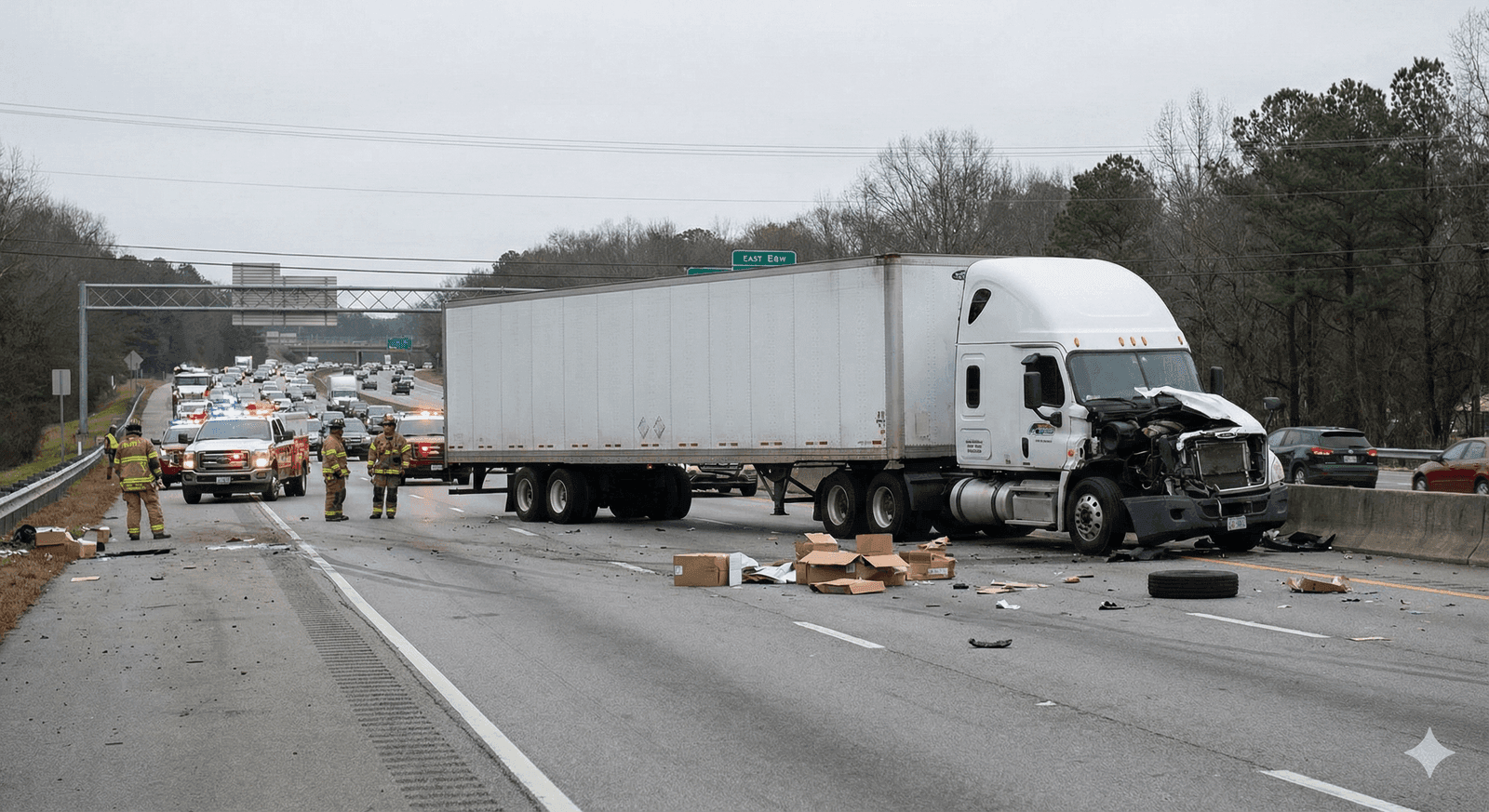
I-4 Truck Accident Lawyer — Orlando's Most Dangerous Freight Corridor
Interstate 4 between Tampa and Daytona Beach is ranked the deadliest interstate in the United States. Through the Orlando metro area, I-4 carries more than 200,000 vehicles daily — including thousands of 18-wheelers, tanker trucks, and flatbeds serving Central Florida's theme parks, distribution centers, and construction sites. The I-4 corridor through Orange and Seminole counties sees constant truck crash activity, from the I-4/I-275 junction in Hillsborough County through the downtown I-4/SR 408 interchange and the SR 417 split in Seminole County.
Call HOV Law at (407) 801-0101 for a free consultation with an I-4 truck accident lawyer — available 24/7.
The I-4 Truck Accident Crisis by the Numbers
The statistics on Interstate 4 truck crashes describe a corridor in crisis. The numbers below come from federal and state safety authorities — not industry estimates — and they explain why HOV Law treats I-4 truck cases as a distinct legal specialty.
I-4 is the only U.S. roadway with more than one fatality per mile, according to a Teletrac Navman analysis of NHTSA Fatality Analysis Reporting System (FARS) data — placing it #1 among America's 25 deadliest roads. The 132-mile corridor stretches from Tampa to Daytona Beach and passes through the heart of Orlando.
NHTSA FARS data shows 34 fatal crashes per 100 miles on I-4 — roughly 45 fatal crashes per year on the 132-mile stretch. From 2016 through 2019 alone, the Orlando section of I-4 recorded 150 fatalities. Heavy truck involvement contributes disproportionately to those numbers because of the speed differential between 80,000-pound commercial vehicles and passenger cars.
Statewide context from the Florida Department of Highway Safety and Motor Vehicles (FLHSMV) confirms how concentrated truck crash exposure is in Central Florida. FLHSMV-reported data documents 44,217 commercial motor vehicle crashes statewide in a recent reporting year. Orange County alone accounted for 2,632 commercial motor vehicle crashes, 12 fatalities, and 971 injuries — among the highest CMV crash totals of any Florida county outside South Florida.
Looking specifically at large-truck fatal crashes in Florida, NHTSA recorded 366 large trucks involved in fatal Florida crashes in a recent reporting year, with 373 total deaths — including 264 passenger-vehicle occupants and 63 pedestrians, cyclists, and motorcyclists. The Insurance Institute for Highway Safety identifies Florida as one of only two states (with California) where more than 50 non-occupants were killed in large-truck crashes in 2023.
I-4 Mile-by-Mile: The 12 Most Dangerous Stretches for Truck Crashes
- Our attorneys have investigated truck crashes at every major I-4 interchange between Tampa Bay and Daytona Beach. The 12 segments below are the corridor's most consistent truck crash hotspots—based on FDOT crash analysis publications, FHP traffic homicide investigations, and the cases we have personally handled.
- I-4/I-275 Junction (Hillsborough County)—The western terminus of I-4 in downtown Tampa is where long-haul freight from Port Tampa Bay merges onto the eastbound corridor. Heavy 18-wheeler concentration combined with urban congestion and complex lane shifts produces frequent rear-end and sideswipe crashes that end up litigated in either Hillsborough or Orange County depending on where the injured plaintiffs reside.
- I-4/SR 570 Polk Parkway (Polk County)—The Polk Parkway interchange near Lakeland is a major freight transfer point. Trucks exiting I-4 to reach Polk County distribution centers must navigate steep grade changes and tight ramp geometry — conditions that produce regular jackknife and rollover crashes when loads shift.
- I-4/SR 559 Polk City Exit (Polk County)—The rural Polk City interchange and the long approach grades on either side are a chronic truck rollover zone. Aggregate haulers serving phosphate mines and citrus operations frequently exceed posted speed limits on the descents, and rollovers here regularly close eastbound lanes for hours.
- I-4/US 27 (Polk County, Champions Gate/Davenport)—US 27 is a primary truck-stop corridor with multiple large fuel and rest facilities. Trucks accelerating onto I-4 from inadequate acceleration lanes and trucks decelerating to exit to the truck stops generate a constant pattern of merge-related collisions.
- I-4/US 192 Interchange (Kissimmee, Osceola County)—The Kissimmee interchange carries heavy freight traffic destined for Walt Disney World, Celebration, and South Florida, plus dense tourist passenger-vehicle traffic. The conflict between heavy commercial vehicles and tourists unfamiliar with the road causes frequent late-night and early-morning fatigued-driver crashes.
- I-4/Sand Lake Road (Orange County)—Sand Lake Road serves the International Drive tourism corridor and the major resorts and outlet malls along it. Delivery trucks, tour buses, and theme-park supply 18-wheelers crowd both the exit and entrance ramps, with frequent rear-end crashes when traffic backs up onto the interstate mainline.
- I-4/Princeton Street and Par Street (Orange County)—These adjacent downtown Orlando interchanges sit inside the I-4 Ultimate construction zone, where lane shifts, narrow shoulders, and concrete barrier systems give heavy trucks no room to maneuver. Construction-zone rear-end crashes here are a regular cause of our intake calls.
- I-4/SR 408 Downtown Interchange (Orange County)—The most complex interchange in Orlando and one of the highest-volume truck-crash sites in Central Florida. I-4 meeting the East-West Expressway downtown produces constant lane-change conflicts between 18-wheelers and passenger vehicles, plus jackknife and pileup crashes during rush hour and afternoon thunderstorms.
- I-4/SR 50 Colonial Drive (Orange County)—Colonial Drive carries heavy local truck traffic — delivery vehicles, construction equipment, and medium-duty fleet vehicles. The I-4/SR 50 interchange sees frequent rear-end crashes as trucks slow to exit and intersection crashes once trucks reach Colonial.
- I-4/SR 434 and SR 436 Interchanges (Altamonte Springs, Seminole County)—These adjacent Seminole County interchanges see significant truck crash activity during rush hours, when commercial vehicles unable to slow quickly enough rear-end stopped or slowed traffic on the exit and merge ramps. The I-4/SR 436 interchange in particular is a known crash cluster for fatigued long-haul drivers running between Tampa and Daytona.
- I-4/Lake Mary Boulevard and SR 46 (Seminole County)—The Lake Mary corridor is one of Central Florida's fastest-growing employment centers and a magnet for delivery and fleet vehicle traffic. The I-4/Lake Mary Boulevard interchange is a frequent location for crashes involving Amazon DSP vans, FedEx Ground vehicles, and contractor pickup trucks running between Lake Mary and Orlando.
- I-4/SR 472 Deltona / Orange City (Volusia County)—The northeast end of the corridor between DeBary and Orange City sees high-speed long-haul traffic running between Orlando and Daytona. Fatigued-driver crashes — particularly during early-morning and late-night hours — are the dominant crash pattern here.
The I-4 Ultimate Construction Project & Truck Crash Liability
The I-4 Ultimate reconstruction project was a $2.3 billion FDOT-led rebuild of 21 miles of I-4 between Longwood (Seminole County) and SR 435 near International Drive (Orange County). The active construction phase of the project ran from 2015 to 2021, and lingering work on tolled express lanes, ramp realignments, and signage continues to make the I-4 corridor through Orlando one of the country's longest-running active work zones for heavy trucks.
For truck crashes that occurred during the active construction phase and for any crashes occurring in remaining work-zone segments, Florida law treats active work zones as a special category of road hazard. Florida Statute § 316.0741 establishes work-zone designation rules, and Florida Statute § 316.1893 sets enhanced "Work Zone Safety" penalties — including doubled traffic fines — for violations committed in active work zones. Florida's 4,677 reported highway construction zone crashes in 2021 (per FLHSMV) underscore how concentrated this risk became during the peak Ultimate years.
Federal Motor Carrier Safety Administration rules further require commercial drivers to reduce speed and increase following distance in construction zones (see 49 CFR § 392.14 on adverse conditions). When a tractor-trailer fails to reduce speed in an I-4 work zone and rear-ends slowed or stopped traffic, that FMCSA violation becomes direct evidence of negligence in the civil case — separate from any traffic citation issued at the scene.
I-4 Ultimate truck crash claims also expand the universe of potential defendants. In addition to the truck driver and motor carrier, claims may extend to FDOT and its prime contractor (SGL Constructors, the design-build joint venture that delivered the project) for inadequate temporary traffic control, inadequate sight distance, defective channelizing devices, or insufficient lane demarcation. Sovereign immunity caps under Florida Statute § 768.28 limit recovery against governmental defendants, but those caps do not extend to the private contractor partners.
HOV Law has handled multiple I-4 construction zone truck crash cases through the Ultimate project years. Our office is at 135 W Central Blvd in downtown Orlando — inside the construction zone itself — and we know exactly which contractor relationships and which traffic-control plans apply at each milepost.
Evidence Unique to I-4 Truck Crashes
FDOT Traffic Cameras and the SunGuide ITS System — FDOT operates hundreds of pan-tilt-zoom cameras along the I-4 corridor as part of the SunGuide Intelligent Transportation System, plus the public-facing Florida 511 traveler-information feed. SunGuide camera footage is the single most valuable evidence source after an I-4 truck crash. Routine retention is short, but written preservation demands and (when necessary) emergency court orders prevent destruction.
SunPass Toll Plaza and Express Lane Records — I-4 Express toll gantries and the SunPass system record vehicle identification (license plate or transponder), exact timing, and lane position for every passing vehicle. SunPass data places the defendant truck on a specific lane at a specific second — invaluable for proving speed, position, and following distance.
FHP Computer-Aided Dispatch (CAD) and Traffic Homicide Investigations — Florida Highway Patrol maintains CAD records of every dispatch and response to an I-4 incident. For fatal and serious-injury truck crashes, FHP assigns a Traffic Homicide Investigator (THI) who produces a comprehensive technical investigation report — typically released months after the crash. The CAD record and any preliminary investigation notes can be obtained much sooner through public records requests.
FDOT Incident Management Team Reports — FDOT operates Road Rangers and incident management response teams that arrive at major I-4 crashes within minutes. Their dispatch records, photographs, and lane-closure logs document scene conditions before any cleanup. These records are public but must be requested through the FDOT District 5 office.
Construction Zone Surveillance — In active work zone segments, the prime contractor (SGL Constructors for the I-4 Ultimate footprint) operates its own surveillance and incident-recording systems for liability and safety-compliance purposes. This footage is privately held but discoverable in litigation.
Adjacent Business and Gas Station Cameras — Properties immediately adjacent to I-4 interchanges — gas stations, hotels, restaurants, and warehouses — often have exterior cameras capturing ramp activity and frontage road traffic. Most overwrite within 30 to 90 days. Same-day canvassing for these recordings is one of the highest-yield investigative steps after an I-4 truck crash.
The Spoliation Letter Process — Within hours of being retained on an I-4 truck case, HOV Law sends formal spoliation preservation demands to: the motor carrier (truck black box / EDR, ELD records, driver qualification file, dashcam footage, dispatch records); FDOT (SunGuide camera recordings and Incident Management Team reports); the toll authority (SunPass transponder and plaza data); FHP (CAD records and any preliminary THI documentation); and any private surveillance custodians identified in the canvass. When carriers or other custodians threaten destruction, we seek emergency court orders.
The First 5 Hours After an I-4 Truck Crash
Hour 1 — Emergency Response. EMS, FHP, FDOT Road Rangers, and the truck's own employer dispatch toward the scene. Lane closures are established. Victims are extricated and transported to Orlando Regional Medical Center, AdventHealth Orlando, or another Level I trauma center. FHP begins its initial investigation. The crash scene itself is the strongest evidence — and it is documented now or never.
Hour 2 — FHP Investigation Begins in Earnest. If the crash involves a fatality or serious injury, an FHP Traffic Homicide Investigator (THI) responds. Skid marks, debris fields, vehicle positions, fluid trails, and damage patterns are photographed and measured. The truck driver is interviewed (if able). Witness statements are taken from passengers and motorists who stopped at the scene. These hours produce the FHP's baseline factual record.
Hour 3 — Trucking Company Rapid Response Team Arrives. Major motor carriers operating on I-4 maintain on-call rapid-response teams of defense lawyers, accident reconstructionists, biomechanical engineers, and adjusters trained to reach Florida crash scenes within hours. They photograph the scene, take possession of the truck and trailer for "inspection," and obtain statements from witnesses and from the truck driver — establishing the carrier's preferred narrative before any plaintiff's lawyer is involved. By the end of Hour 3, the carrier knows more about the crash than anyone except the people who were in it.
Hour 4 — Tow, Scene Clearance, and the Beginning of Evidence Loss. FDOT and contracted wreckers clear the wreckage. Lane closures are reopened. Scene evidence — debris, fluid trails, vehicle position markings — is gone. The truck and trailer are taken to a yard that the motor carrier controls or selects. Without an immediate spoliation letter, the carrier can lawfully begin repairs, dispose of damaged components, and start overwriting telematics data.
Hour 5 — Evidence Begins to Disappear. ELD systems begin overwriting older driver-status records under FMCSA retention defaults. Dashcam footage cycles. Dispatch communication logs are not preserved unless specifically retained. SunGuide and SunPass records remain available for a period but are routine, not litigation-preserved. The first formal spoliation demand from a plaintiff's lawyer at this hour is what locks the entire body of evidence in place.
HOV Law's office at 135 W Central Blvd is minutes from the I-4/SR 408 interchange — the most crash-prone segment of the entire corridor. When a client or family calls our 24/7 line after a serious I-4 crash, we begin sending preservation demands immediately while the trucking company's response team is still en route to the scene.
I-4 Truck Accident Sub-Types We Handle
Florida Laws That Affect Your Case
Statute of Limitations
In Florida, you have a limited time to file your claim: 2 years for negligence (FL Statute § 95.11). Missing this deadline typically means you lose your right to compensation permanently.
“Time is your most valuable asset after an injury. Contact an Orlando attorney immediately to ensure your claim is preserved.”
Modified Comparative Negligence
Florida follows a modified comparative negligence system. If you are found to be more than 50% at fault, you are barred from recovering any damages. Otherwise, your compensation is reduced by your percentage of fault.
Florida Insurance System
Florida operates under a No-Fault (PIP required) system. $10,000 PIP coverage required.
Key Florida Legal Facts
Federal Hours-of-Service Regulations
Commercial trucks and their drivers are governed by federal FMCSA regulations, not just state traffic law. Drivers are capped at 11 hours of driving after 10 consecutive hours off duty, cannot drive past the 14th hour after coming on duty, and must take a 30-minute break after 8 hours behind the wheel (49 CFR § 395). Violations of these hours-of-service rules — provable through the truck's electronic logging device — are powerful evidence of negligence in a truck accident claim.
Local Knowledge: Orlando
High-Risk Roads & Highways
- I-4 (one of the deadliest highways in America)
- SR 408
- Colonial Drive (SR 50)
- Orange Blossom Trail
Local Courts
- Orange County Courthouse
- Ninth Judicial Circuit Court
Areas We Serve Near Orlando
- Kissimmee
- Winter Park
- Sanford
- Altamonte Springs
- Apopka
Orlando Landmarks
- Downtown Orlando
- International Drive
- Lake Eola
- Universal Studios
What Compensation May Cover
Under Florida law, you may be entitled to recover damages for the full impact of your injuries.
Economic Damages
- • Medical bills (past & future)
- • Lost wages & earning capacity
- • Property damage
- • Rehabilitation costs
Non-Economic Damages
- • Pain and suffering
- • Mental anguish
- • Loss of consortium
- • Physical impairment
Related Practice Areas in Orlando
I-4 Truck Accidents cases often involve overlapping injuries and legal claims. Our Orlando attorneys also handle these related areas:
Other Personal Injury Services in Orlando
Also serving Orlando for Criminal Defense:
Serge Hovhanessian, Esq.
Founding Attorney at HOV Law | Florida Bar | Million Dollar Advocates Forum | Top 40 Under 40 Trial Lawyers
Attorney Hovhanessian represents personal injury victims across Florida — no fee unless we win.Read full bio →
Verified 5-Star Google Reviews
What Orlando Clients Say About HOV Law
A 5.0-star average across 293 Google reviews. Hear directly from clients we've represented in Orlando and across Florida.
Orlando I-4 Truck Accidents FAQs
Why is I-4 so dangerous for truck crashes near Orlando?
I-4 is ranked the deadliest interstate in the United States — the only U.S. roadway with more than one fatality per mile, according to Teletrac Navman analysis of NHTSA FARS data. Through Orlando, the corridor carries more than 200,000 vehicles daily, including thousands of 18-wheelers, tanker trucks, and freight haulers running between Tampa, Orlando, and Daytona Beach. The I-4 Ultimate construction footprint, tourist drivers unfamiliar with the road, sudden Florida thunderstorms, and fatigued long-haul truckers all compound the danger. The downtown I-4/SR 408 interchange is one of the highest-volume and most crash-prone segments anywhere on the corridor.
What evidence is available after an I-4 truck crash in Orlando?
I-4 truck crashes generate more independent evidence than almost any road in Florida — but most of it is overwritten within days. Critical evidence sources include the truck's own Event Data Recorder (EDR/black box), Electronic Logging Device (ELD) records, and any dashcam footage; FDOT SunGuide overhead traffic cameras along the corridor; SunPass toll-plaza and express-lane records; FHP Computer-Aided Dispatch (CAD) records and Traffic Homicide Investigation (THI) reports for fatal crashes; FDOT Incident Management Team logs; construction-zone surveillance held by the prime contractor; and exterior cameras from gas stations, hotels, and businesses adjacent to I-4 interchanges. HOV Law sends preservation demands to every relevant custodian the day we are retained.
What if my crash happened in the I-4 Ultimate construction zone?
Florida Statute § 316.1893 doubles traffic fines in active "Work Zone Safety" zones, and FMCSA rule 49 CFR § 392.14 requires commercial drivers to reduce speed and increase following distance in construction zones. When a truck driver fails to comply in an I-4 work zone and rear-ends slowed traffic, those violations are direct evidence of negligence in the civil case. The defendant universe also expands beyond the carrier — FDOT, the prime contractor (SGL Constructors on the I-4 Ultimate footprint), and channelizing-device subcontractors can all face liability for inadequate temporary traffic control or sight distance.
How long do I have to file a lawsuit after an I-4 truck crash?
Florida Statute § 95.11(3) gives you 2 years from the accident date to file a personal injury lawsuit (reduced from 4 years by the 2023 tort reform). For wrongful death under FL § 768.16–768.26, the 2-year clock starts from the date of death. If FDOT or another governmental defendant is involved, additional pre-suit notice requirements under FL § 768.28 apply, and sovereign-immunity caps limit recovery. FDOT camera footage and construction-zone surveillance are overwritten on routine retention cycles — contact HOV Law immediately so we can preserve independent evidence from the I-4 corridor before it is gone.
What FDOT camera footage is available after an I-4 truck crash?
FDOT operates hundreds of pan-tilt-zoom cameras along I-4 as part of the SunGuide Intelligent Transportation System, plus the public-facing Florida 511 traveler-information feed. SunGuide camera coverage spans nearly the entire I-4 corridor through Orange, Seminole, and Osceola counties, and the footage is the single most valuable independent evidence source after a major I-4 truck crash. Routine retention is short — typically a matter of days — but a formal written preservation demand to FDOT District 5 and (when necessary) an emergency court order will lock the footage in place. HOV Law sends these demands the same day we are retained.
How does the I-4 Ultimate construction zone affect my truck accident claim?
The I-4 Ultimate project was a $2.3 billion FDOT-led rebuild of 21 miles of I-4 between Longwood (Seminole County) and SR 435 near International Drive (Orange County). Crashes in active work-zone segments expose a broader defendant pool: in addition to the truck driver and motor carrier, claims may extend to FDOT and to SGL Constructors (the design-build prime contractor that delivered the I-4 Ultimate scope) for inadequate temporary traffic control, signage, sight distance, or channelizing devices. Sovereign-immunity caps under FL § 768.28 limit recovery against the governmental defendants, but those caps do not extend to the private contractor partners — which is often where the meaningful insurance is.
Can I sue FDOT if I-4 road conditions contributed to my truck crash?
Yes, but Florida's sovereign-immunity statute (FL § 768.28) imposes specific limits. Plaintiffs must serve a pre-suit notice of claim on the Florida Department of Financial Services and on FDOT itself, and damages against any single state agency are capped at $200,000 per claimant and $300,000 per incident — unless the Florida Legislature passes a claims bill authorizing payment above the cap. The procedural requirements are strict and the deadlines are short. When road conditions are a factor in an I-4 truck crash, HOV Law evaluates governmental liability alongside the carrier claim — and we structure the case so that the cap does not limit recovery from the private defendants.
What if my I-4 truck crash happened in Seminole County instead of Orange County?
It matters because the case will be filed in a different circuit. Crashes in Orange County are litigated in the Ninth Judicial Circuit at the Orange County Courthouse in downtown Orlando. Crashes in Seminole County (the segment between Lake Mary, Altamonte Springs, and the SR 472 area) are litigated in the Eighteenth Judicial Circuit, primarily at the Seminole County Civil Courthouse in Sanford. Osceola County crashes (the I-4/US 192 interchange in Kissimmee and points south) are litigated in the Ninth Judicial Circuit's Osceola County Courthouse. HOV Law's attorneys practice in all three circuits — the substantive Florida law is the same, but the local rules, assigned judges, and jury demographics differ in ways that affect strategy.
I-4 Truck Crash
Attorney Available Now
HOV Law is based in downtown Orlando minutes from I-4's most dangerous interchanges. We preserve FDOT camera footage, toll records, and truck black box data the same day you call.