
Orlando Dump Truck Accident Lawyer
Construction Vehicle & Dump Truck Crash Attorneys in Orlando & Orange County
Legal representation for victims of dump truck and construction vehicle accidents. Serving Orlando, Orange County, and all of Florida.
Holding Construction
Companies Accountable
Orlando Construction Boom Expertise
Central Florida's construction explosion — Lake Nona Medical City, Horizon West, SunRail expansion, I-4 Ultimate reconstruction, and hundreds of commercial projects across Orange, Seminole, and Osceola counties — puts thousands of dump trucks on local roads daily. HOV Law has specific experience pursuing crash claims against dump truck operators and the construction companies that deploy them.
Weight Limit and Overloading Violations
Overloaded dump trucks are endemic on Orlando's construction corridors. When a dump truck exceeds Florida's per-axle weight limits or the federal 80,000-pound bridge formula limits, braking distances increase dramatically and rollover risk rises sharply. HOV Law obtains weigh station bypass records, bill of lading data, and shipper records to prove overloading violations.
Multi-Party Construction Liability
Dump truck crashes in Orlando often expose liability beyond the driver and the truck company — to the general contractor who directed operations, the project owner who retained the contractor, and the cargo loader who overfilled the truck. HOV Law investigates every level of the construction project hierarchy to identify all responsible parties.
Orlando's Construction Boom
Creates Daily Danger
Orange County is one of the fastest-growing counties in the United States. New residential developments in Lake Nona, Horizon West, Hamlin, and Waterford Lakes. Ongoing commercial construction on SR 50, SR 429, and Colonial Drive. The I-4 Ultimate and SunRail expansion. Thousands of dump trucks, cement mixers, and aggregate haulers on roads that were not designed for their weight and turning radius. When these vehicles crash, the liability extends from the driver through the general contractor and project owner.
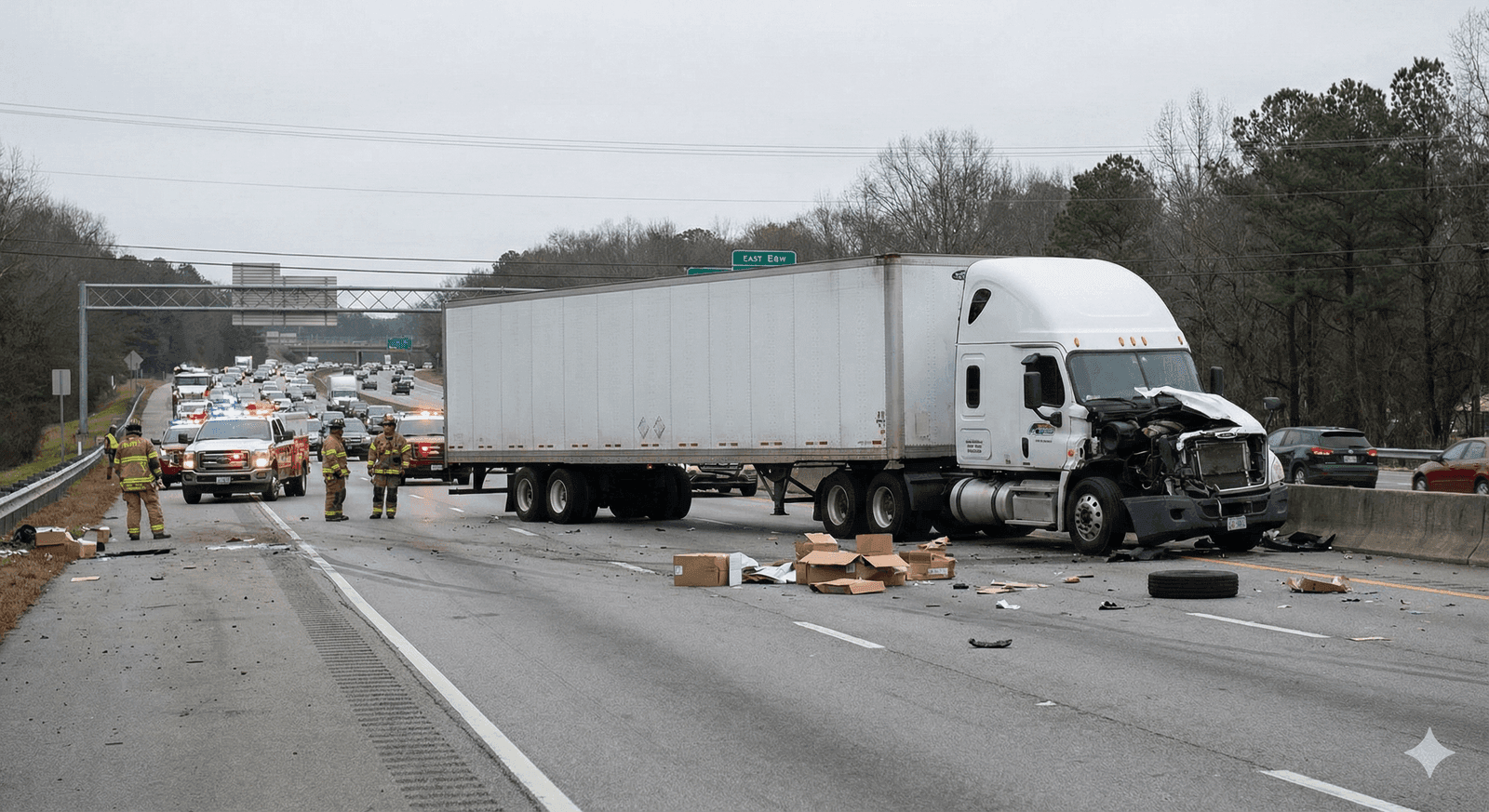
Orlando Dump Truck Accident Lawyer — Construction Vehicle Crash Claims
Dump truck accidents in Orlando are a daily occurrence on the construction corridors serving Central Florida's development boom. SR 50 in west Orange County, SR 429 (Western Beltway), Narcoossee Road in Lake Nona, Alafaya Trail near UCF, and Avalon Road in Horizon West all carry heavy dump truck and construction vehicle traffic to sites where thousands of new homes, commercial buildings, and roads are under construction.
Call HOV Law at (407) 801-0101 for a free consultation with an Orlando dump truck accident lawyer — available 24/7.
Who Is Liable for a Dump Truck Crash in Orlando?
- Dump truck accidents in Orlando frequently expose liability across multiple parties in the construction project chain. For a plain-language overview of how truck-crash liability is apportioned in Florida, see our guide on who is liable for a truck accident in Florida:
- The Dump Truck Driver—Direct negligence for speeding through construction corridors, improper turns on narrow local roads, overloading, failure to properly secure the load cover, or operating with expired CDL credentials.
- The Dump Truck Company—Employer liability for the driver's negligence, plus direct liability for inadequate maintenance, failed brakes, worn tires, and overloading the truck beyond legal weight limits.
- The General Contractor—Construction GCs in Orlando who direct, schedule, and control dump truck hauling operations may be directly liable for crashes that occur as part of project operations.
- The Project Owner—Property owners who retain operational control over construction activities at their Orlando development site can face premises liability or direct negligence claims alongside the GC.
- The Cargo Loader—When a third-party loader at a quarry, asphalt plant, or recycling facility loads the dump truck beyond legal capacity or fails to secure the load cover, that party shares liability for downstream crashes on Orlando roads.
The Central Florida Construction Boom and the Orlando Dump Truck Crash Rate
Orange County is one of the fastest-growing counties in the United States, and the construction activity supporting that growth has put thousands of dump trucks on Orlando-area roads daily. The geographic pattern of where construction is happening drives the geographic pattern of where dump truck crashes occur.
Lake Nona — Lake Nona Medical City and the surrounding residential development have produced a sustained, decade-long construction operation in southeast Orange County. Narcoossee Road, Lake Nona Boulevard, Dowden Road, and Tavistock Lakes Boulevard carry continuous dump truck traffic between borrow pits, concrete plants, and active building sites. Crashes involving turning, backing, and loaded dump trucks on these roads are common.
Horizon West (Hamlin, Winter Garden, Bay Lake) — The Horizon West master-planned community in southwest Orange County is among the largest active residential developments in Florida. New phase development in Hamlin Town Center, Bay Lake, and the surrounding Hartzog Road, New Independence Parkway, and Reams Road corridors generates intense dump truck and aggregate-hauler traffic on roads that were originally laid out as rural two-lane routes.
Apopka and West Orange County — Northwest Orange County continues to develop along SR 414, SR 436, and US 441 corridors. Apopka's commercial and warehouse development relies on continuous dump truck activity between the area's many borrow pits and active job sites.
SR 429 Western Beltway Corridor — SR 429 is the spine of Orange County's western development boom. The road itself remains under active widening and connection work, and the corridor carries an enormous volume of construction vehicles between borrow pits in north and west Orange County and active build sites in Horizon West, Winter Garden, and Ocoee.
Aggregate Hauling from Polk County Quarries — Much of the aggregate (limestone, sand, gravel) used in Orlando-area construction originates at quarries in Polk County. Loaded aggregate haulers travel I-4 east into Orange County and then onto SR 429 or local arterials to reach build sites. These loaded long-distance haulers run on tight schedules and often exceed posted weight limits, increasing the rollover and brake-failure risk along I-4 and the connector roads.
Why This Geography Matters in Your Case — When a dump truck causes a crash on a specific Orlando road, the location often tells us the most likely originating quarry, the most likely receiving job site, and therefore the most likely set of defendants. HOV Law uses the location, the load type, and the time of day to identify the originating yard, the contracting trucking company, the receiving GC, and the project owner — often before the carrier has finished its own internal investigation.
Dump Truck Weight Violations and the Florida Bridge Formula
Overweight dump trucks are one of the most dangerous and most actionable categories of commercial vehicle violation. Federal and state weight laws are precise, and proof of overweight operation produces a near-automatic finding of negligence in civil cases.
Florida Weight Limits — FL § 316.535 — Florida Statute § 316.535 sets the maximum gross vehicle weights for trucks operating on Florida public roads, with per-axle limits, gross combination limits, and special provisions for tandem axles, tridem axles, and multi-axle dump truck configurations common in Florida. Operating above these limits without a state-issued overweight permit is a per-se violation.
The Federal Bridge Formula — 49 CFR § 658.17 — The federal Bridge Formula (also called the Federal Bridge Gross Weight Formula) limits how much weight can sit between any group of axles, based on the spacing between those axles and the number of axles in the group. The formula's purpose is to protect bridges from concentrated loads. Dump trucks moving aggregate or fill on I-4, SR 429, and other state and federal roads must comply with the formula regardless of any state permits issued.
Per-Axle Limits in Practice — Standard per-axle federal limits are 12,000 pounds on a steer axle, 20,000 pounds on any single drive axle, and 34,000 pounds on any tandem axle. Multi-axle dump truck configurations common in Florida (4-axle, 5-axle, and 6-axle straight trucks and tractor-trailer dump combinations) have specific gross-weight maximums that depend on the axle configuration.
Overweight Permit Requirements — Loads that exceed standard limits require state-issued overweight permits from FDOT under FL § 316.550. Permits specify routes, hours, escort requirements, and operating conditions. Trucks operating without the required permit, off the permitted route, or outside permitted hours violate state law directly.
How Weight Violations Are Proven in Civil Cases — HOV Law obtains weigh station records (including PrePass and Drivewyze bypass logs that document the truck's recorded weight at each weigh-station event), the originating quarry's ticket records (which record the weight of the load placed in the truck), and the receiving job site's ticket records (which record the weight discharged at the site). When the ticket weights show an overweight load, the case is structurally simpler — the violation is documentary, and the defenses are few.
Why Overweight Matters Mechanically — An overweight dump truck has dramatically longer braking distance, increased rollover propensity (especially on Florida's exit ramp curves), greater downhill momentum on construction-zone grades, and reduced steering responsiveness. The same crash that a properly loaded truck might have avoided becomes unavoidable for the overweight truck.
Multi-Party Liability in Orlando Construction Dump Truck Crashes
Construction dump truck crashes generate some of the most complex multi-party liability questions in Florida personal injury law. Identifying every responsible party is what separates a thoroughly investigated case from one that leaves money on the table.
The Trucking Company's Direct and Vicarious Liability — Direct liability for negligent maintenance, failure to enforce weight limits, and inadequate driver training. Vicarious liability under respondeat superior for the driver's on-duty negligence. The carrier's commercial auto policy is typically the primary recovery source.
General Contractor Liability — FL § 768.0710 and Common Law — Florida Statute § 768.0710 imposes a duty on premises owners and the GC to exercise reasonable care for the safety of business invitees and lawful visitors. For dump truck operations directed by the GC, the GC may be liable for negligent scheduling (back-to-back loads creating fatigue), negligent supervision of the truck movements at the job site, inadequate traffic control at site entrances and exits, and inadequate communication with the public road authority for haul-route impacts.
Subcontractor and Site Operator Liability — Where the truck operation is contracted through a subcontractor rather than the GC directly, the sub may be the primary contracting party. Subcontractor liability follows the same general framework as GC liability but is often easier to establish because the sub has more direct operational control over the specific dump truck activity.
Project Owner Liability — Florida law generally limits project-owner liability to situations where the owner retained operational control over the construction activity that produced the crash. For owner-operated developments or owners who acted as their own general contractor, this can produce direct liability. Pure passive ownership without operational involvement generally does not produce liability under Florida law.
Workers' Compensation Exclusivity vs Third-Party Claims — When the injured person is a fellow construction worker on the same project, Florida's workers' compensation exclusivity (FL § 440.11) typically bars the worker from suing the employer or a fellow employee directly, but does not bar third-party claims against the dump truck company, the dump truck driver, or other non-employer construction parties. For members of the public (motorists, pedestrians, cyclists) who are not project workers, exclusivity does not apply at all.
Premises Liability on the Job-Site Entrance and Exit — Crashes occurring at the immediate entrance or exit of an Orlando construction site frequently involve premises liability theories layered on top of motor vehicle liability. Inadequate sight distance, missing traffic-control devices, mud or aggregate tracked onto the public road, and inadequate signage all support claims against the GC and site operator independent of the dump truck driver's conduct.
Aggregate, Concrete, and Cement Mixer Crashes in Orlando
Beyond the standard dump truck, the Orlando construction supply chain produces frequent crashes involving cement mixers and other specialized aggregate haulers. These vehicles have unique physical and operational characteristics that drive specific crash patterns and unique injury categories.
Cement Mixer Center-of-Gravity and Rollover Risk — Cement mixers carry their wet-concrete load in a rotating drum mounted high on the chassis. The resulting high center of gravity makes mixers significantly more rollover-prone than standard dump trucks, especially on exit-ramp curves on SR 408, SR 417, the Florida Turnpike, and the I-4 interchanges. Mixers that roll on Orlando construction-zone ramps typically close lanes for hours and may produce secondary crashes.
The "Slosh" Phenomenon — Wet concrete in a partially full drum slides during cornering, braking, and acceleration. The resulting slosh dynamic shifts the center of gravity dynamically and can produce loss of control even at moderate speeds. Cement mixer drivers receive specialized training in load-management techniques; failure to apply that training is itself a negligence theory.
Concrete Delivery Scheduling Pressure — Wet concrete has a limited "in-truck" working window, typically about 90 minutes from the time the cement plant adds water until the concrete must be discharged. This scheduling pressure incentivizes speeding and aggressive driving on the route from the cement plant (often Cemex, Florida Rock, Argos, or other major suppliers) to the Orlando-area job site. Delayed deliveries become loads that must be discarded — a financial loss to the driver and the supplier that drives unsafe behavior.
Cement Burns and Chemical Exposure Injuries — Wet concrete contains calcium hydroxide and other strongly alkaline compounds. Skin contact during a spill produces chemical burns that can be severe even after immediate decontamination. Crashes involving spilled wet concrete on Orlando roads can cause exposure injuries to passing motorists, pedestrians, and first responders that are categorically different from typical crash injuries.
Aggregate Hauler Specifics — Beyond cement mixers, aggregate haulers carry limestone, sand, gravel, fill, and recycled material from quarries to Orlando job sites. Improperly tarped loads cause highway debris incidents; improperly secured tailgates can drop loads at intersections; overweight loads compound braking and rollover risks. The aggregate hauler's contract with the quarry, the receiving GC, and the broker who arranged the haul are all relevant to identifying the defendant universe.
Florida Laws That Affect Your Case
Statute of Limitations
In Florida, you have a limited time to file your claim: 2 years for negligence (FL Statute § 95.11). Missing this deadline typically means you lose your right to compensation permanently.
“Time is your most valuable asset after an injury. Contact an Orlando attorney immediately to ensure your claim is preserved.”
Modified Comparative Negligence
Florida follows a modified comparative negligence system. If you are found to be more than 50% at fault, you are barred from recovering any damages. Otherwise, your compensation is reduced by your percentage of fault.
Florida Insurance System
Florida operates under a No-Fault (PIP required) system. $10,000 PIP coverage required.
Key Florida Legal Facts
Federal Hours-of-Service Regulations
Commercial trucks and their drivers are governed by federal FMCSA regulations, not just state traffic law. Drivers are capped at 11 hours of driving after 10 consecutive hours off duty, cannot drive past the 14th hour after coming on duty, and must take a 30-minute break after 8 hours behind the wheel (49 CFR § 395). Violations of these hours-of-service rules — provable through the truck's electronic logging device — are powerful evidence of negligence in a truck accident claim.
Local Knowledge: Orlando
High-Risk Roads & Highways
- I-4 (one of the deadliest highways in America)
- SR 408
- Colonial Drive (SR 50)
- Orange Blossom Trail
Local Courts
- Orange County Courthouse
- Ninth Judicial Circuit Court
Areas We Serve Near Orlando
- Kissimmee
- Winter Park
- Sanford
- Altamonte Springs
- Apopka
Orlando Landmarks
- Downtown Orlando
- International Drive
- Lake Eola
- Universal Studios
What Compensation May Cover
Under Florida law, you may be entitled to recover damages for the full impact of your injuries.
Economic Damages
- • Medical bills (past & future)
- • Lost wages & earning capacity
- • Property damage
- • Rehabilitation costs
Non-Economic Damages
- • Pain and suffering
- • Mental anguish
- • Loss of consortium
- • Physical impairment
Related Practice Areas in Orlando
Dump Truck Accidents cases often involve overlapping injuries and legal claims. Our Orlando attorneys also handle these related areas:
Other Personal Injury Services in Orlando
Also serving Orlando for Criminal Defense:
Serge Hovhanessian, Esq.
Founding Attorney at HOV Law | Florida Bar | Million Dollar Advocates Forum | Top 40 Under 40 Trial Lawyers
Attorney Hovhanessian represents personal injury victims across Florida — no fee unless we win.Read full bio →
Verified 5-Star Google Reviews
What Orlando Clients Say About HOV Law
A 5.0-star average across 293 Google reviews. Hear directly from clients we've represented in Orlando and across Florida.
Orlando Dump Truck Accidents FAQs
Who pays if a dump truck injures me near an Orlando construction site?
The dump truck company's commercial auto insurance is the primary source of compensation, typically covering the driver's on-duty negligence under respondeat superior. The general contractor's commercial general liability (CGL) policy may also apply if the GC directed the dump truck operations, and umbrella or excess policies above the primary may be available for catastrophic injuries. The project owner's insurance can cover incidents on or near their property when the owner retained operational control. HOV Law identifies every available insurance policy — including primary, umbrella, and any contractual indemnity arrangements between the truck company, GC, sub, and owner.
What if debris from a dump truck hit my car on an Orlando road?
Debris falling from an improperly covered or overloaded dump truck is one of the most common causes of dump truck crash injuries in Orlando. Florida law requires dump truck operators to cover loads and secure cargo before entering a public road. When debris causes a crash, both the driver and the trucking company face direct liability — and where the load originated at a quarry or loading facility that overfilled the truck, the loader may also share responsibility. Same-day photographs of the debris, the truck (if identifiable), and the crash scene preserve essential evidence; HOV Law also pulls FDOT camera footage and adjacent business surveillance when available.
Can I sue the construction company, not just the dump truck driver?
Yes, in many Orlando dump truck cases. The general contractor that directed and scheduled the dump truck operations can be liable for negligent scheduling (back-to-back loads creating fatigue), negligent supervision at the job site, inadequate traffic control at site entrances and exits, and inadequate communication with the public road authority for haul-route impacts. FL § 768.0710 imposes specific duties on premises owners and operators. Subcontractors who contracted directly with the truck company often have more direct liability than the GC and are sometimes the better-targeted defendant. Project owners who retained operational control of the construction activity can also face direct claims. HOV Law investigates every layer.
How are overweight dump trucks proven in Orlando crash cases?
Overweight operation is one of the most actionable categories of dump truck violation because the proof is documentary. HOV Law obtains weigh-station bypass records (PrePass and Drivewyze logs document the truck's recorded weight at each weigh-station event), the originating quarry's ticket records (which record the weight of the load placed in the truck at the source), and the receiving job site's ticket records (which record the weight discharged). When the ticket weights show an overweight load — exceeding FL § 316.535 limits or the federal Bridge Formula under 49 CFR § 658.17 — the case is structurally simpler: the violation is a per-se finding of negligence, and the defenses are few.
What if a cement mixer rolled and injured me on an Orlando exit ramp?
Cement mixer rollovers on Orlando exit ramps — especially on the I-4, SR 408, SR 417, and Florida Turnpike interchanges — combine motor-vehicle liability with potentially unique injury exposures. Wet concrete is strongly alkaline and can produce chemical burns on skin contact. Rollovers result from the mixer's inherently high center of gravity combined with the "slosh" of wet concrete in a partially filled drum, often compounded by delivery-schedule pressure and aggressive driving from the cement plant to the job site. Liability typically extends to the driver, the cement company (Cemex, Florida Rock, Argos, or another supplier), the receiving GC, and any broker who arranged the delivery. Chemical-exposure damages are evaluated separately from typical crash injuries.
How long do I have to file a dump truck accident lawsuit in Florida?
Florida's statute of limitations under FL § 95.11(3) gives you 2 years from the accident date to file a personal injury lawsuit. For wrongful death, the clock starts from the date of death under FL § 95.11(4)(e). Construction project documents — weight receipts, haul contracts, safety meeting minutes, daily reports — are routinely purged or archived on schedules that can render the evidence harder to obtain even within the 2-year window. Contact HOV Law immediately so we can preserve project records, dump-truck telematics, quarry tickets, and FDOT camera footage from the crash corridor.
Dump Truck Crash
in Orlando?
Dump truck accidents in Orlando involve complex multi-party construction liability. HOV Law is based downtown and investigates immediately — before the job site records are altered or construction company documents are purged.