
Orlando 18-Wheeler Accident Lawyer
Tractor-Trailer & 18-Wheeler Crash Attorneys — I-4, SR 408, Florida Turnpike
Experienced representation for victims of 18-wheeler and tractor-trailer crashes. Serving Orlando, Orange County, and all of Florida.
Fighting 18-Wheeler
Insurance Giants
I-4 and SR 408 Crash Specialists
Interstate 4 through Orlando carries more than 200,000 vehicles daily, including thousands of 18-wheelers hauling freight between Tampa's port and the East Coast. Our Orlando attorneys have handled tractor-trailer crash cases on every mile of I-4 through Orange, Seminole, and Osceola counties — including the I-4/SR 408 downtown interchange, the SR 417 split, and the I-4 Ultimate construction corridor.
FMCSA Violations That Win Cases
Federal Motor Carrier Safety Administration regulations govern hours of service, ELD records, CDL qualification, cargo securement, and drug and alcohol testing for every 18-wheeler on Orlando's roads. When carriers violate FMCSA rules — and many do — those violations become direct evidence of negligence. We subpoena SaferSys safety records and ELD data within hours of being retained.
Same-Day Evidence Preservation
Our office is at 135 W Central Blvd in downtown Orlando. When an 18-wheeler crash happens on I-4, the 408, or Orange Blossom Trail, we send spoliation demands the same day — preserving black box data, ELD logs, dashcam footage, and driver qualification files before the trucking company can destroy them.
Orlando's Most
Dangerous Crashes
An 18-wheeler traveling at 65 mph on I-4 carries 80,000 pounds of force — 20 times a passenger car. When these rigs crash on Orlando's interstates, the injuries are catastrophic and the legal claims are among the most complex in personal injury law. Federal trucking regulations, multi-party liability, and insurance policies of $1 million to $5 million require an attorney who specializes in 18-wheeler crash cases and knows Orlando's roads and courts.
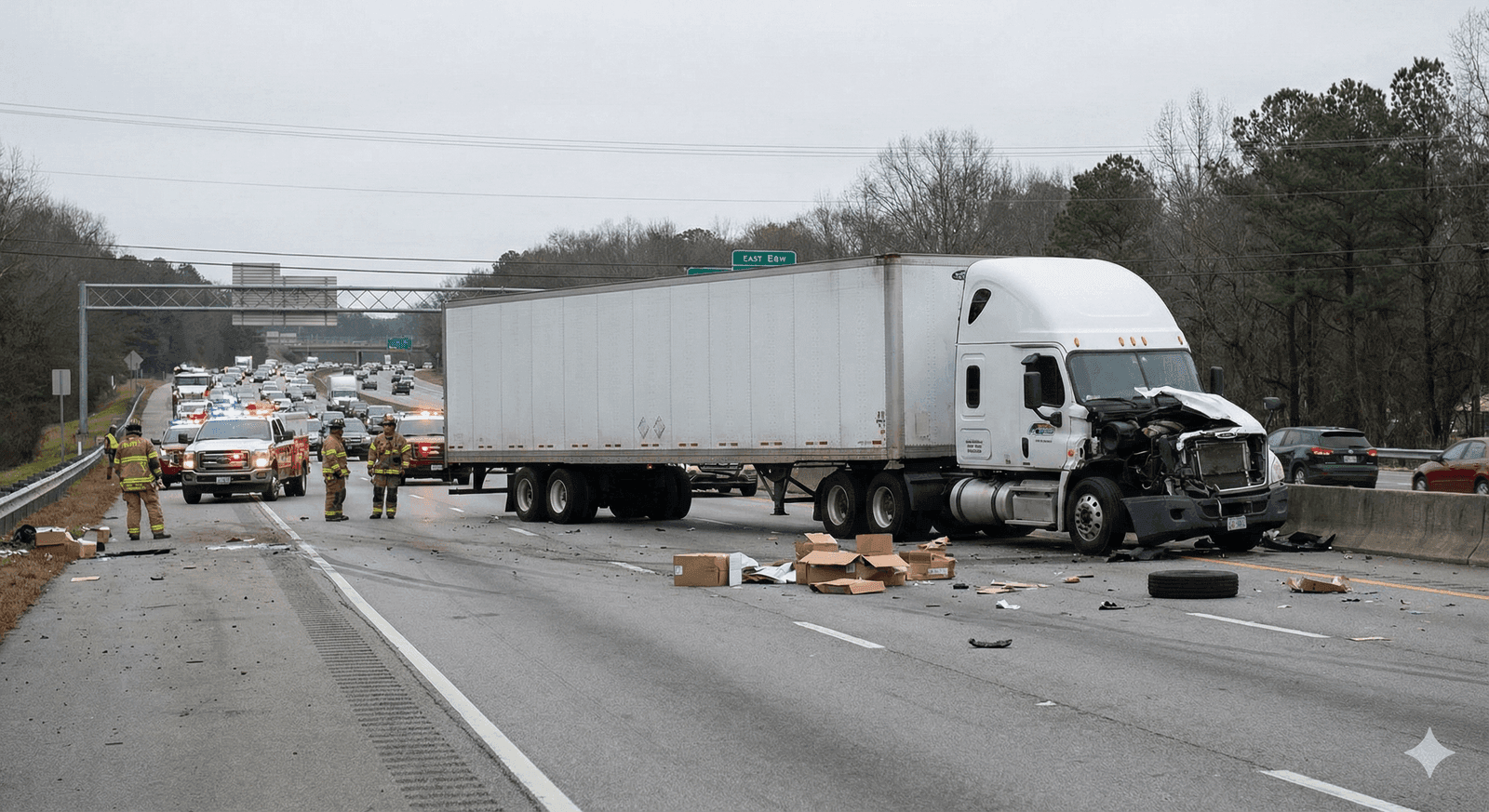
Orlando 18-Wheeler Accident Lawyer — I-4 Tractor-Trailer Crash Representation
Interstate 4 through the Orlando metro area is ranked among the deadliest highways in the United States. Through Orange, Seminole, and Osceola counties, I-4 carries more than 200,000 vehicles daily — including thousands of 18-wheelers, tractor-trailers, and heavy freight rigs moving goods between Tampa's Port, Orlando's distribution centers, and the East Coast. When a crash happens on I-4, SR 408, SR 417, or Florida's Turnpike, the consequences for passengers in smaller vehicles are devastating.
Call HOV Law at (407) 801-0101 for a free consultation with an Orlando 18-wheeler accident lawyer — available 24/7.
Federal Regulations That Govern 18-Wheeler Crashes on Orlando's Roads
- Every interstate 18-wheeler operating on Orlando's roads is subject to FMCSA federal safety regulations. When carriers or drivers violate these rules, the violation becomes direct evidence of negligence in your civil case. Our guide on FMCSA hours-of-service rules explains the federal driving limits these violations break:
- Hours-of-Service Limits—Drivers hauling freight between Tampa, Orlando, and Jacksonville frequently push beyond the 11-hour daily driving limit and 60-hour weekly cap. We pull ELD records, dispatch logs, toll receipts, and fuel records to prove the driver was on duty too long when the crash happened on I-4.
- ELD Tampering and Logbook Fraud—Some carriers operating out of Central Florida's distribution hubs still manipulate electronic logging device records. Forensic analysis of ELD data can expose tampering — and ELD fraud in Orlando truck cases frequently supports punitive damages claims.
- Vehicle Inspection Failures—Carriers that skip mandatory pre-trip inspections on 18-wheelers running the I-4 corridor face direct liability when brake failures, tire blowouts, or steering malfunctions cause crashes. We subpoena DOT inspection records and maintenance logs.
- Drug and Alcohol Testing Violations—Federal law requires pre-employment, random, and post-accident drug and alcohol testing. Carriers that bypass testing or rehire drivers from the FMCSA Drug & Alcohol Clearinghouse without proper protocols face enhanced liability in Orlando 18-wheeler crash cases.
Common Types of 18-Wheeler Crashes on Orlando Roads
- Each type of 18-wheeler collision on Orlando's roads presents distinct legal and engineering challenges:
- I-4 Rear-End Crashes—A loaded 18-wheeler traveling at 65 mph on I-4 needs over 500 feet to stop. When trucks tailgate in slowed traffic near the I-4/SR 408 interchange or the SR 417 split and fail to brake in time, the results are devastating. We use black box data to prove inadequate following distance and excessive speed.
- Jackknife Accidents—When an 18-wheeler's trailer swings outward during hard braking on I-4, it sweeps across multiple lanes, often triggering multi-vehicle pileups. Jackknifes in Orlando's I-4 construction zones are among the most deadly crashes on the corridor.
- Underride Collisions—When a car slides under an 18-wheeler's trailer, the passenger compartment is sheared off at the roof line. Federal underride guard standards are inadequate, and many trailers on Orlando roads lack sufficient rear or side underride protection.
- Cargo Spill Crashes—Improperly secured loads on 18-wheelers traveling the Florida Turnpike and SR 417 create deadly highway debris incidents. When cargo falls onto the roadway, liability extends to both the carrier and the shipper or loader who secured the load.
- Tire Blowout Incidents—A tire blowout at highway speed on I-4 can cause an 18-wheeler driver to lose control and strike multiple vehicles. Blowouts result from inadequate tire inspection — a direct FMCSA maintenance violation.
18-Wheelers vs Other Commercial Trucks — Why the Distinction Matters
Not every "truck accident" is an 18-wheeler accident, and the differences matter. An 18-wheeler — also called a tractor-trailer, semi-truck, or big-rig — is a Class 8 combination commercial vehicle with a gross vehicle weight rating (GVWR) greater than 26,000 pounds and, fully loaded, a maximum federal gross vehicle weight of 80,000 pounds. The "18-wheeler" name comes from the standard configuration: 10 wheels on the tractor (2 steer plus 8 drive) and 8 wheels on the trailer (4 on each tandem axle).
Federal Interstate Regulation — Almost every 18-wheeler operating in Florida engages in interstate commerce, which triggers comprehensive FMCSA jurisdiction. That regulatory layer does not apply to intrastate-only delivery vans, smaller box trucks, or company fleet vehicles. The denser regulatory framework on 18-wheelers translates directly into more potential negligence-per-se theories in civil claims — every FMCSA rule violation is a separate factual basis for liability.
CDL Class A Requirement — Operating an 18-wheeler requires a Commercial Driver's License (CDL) Class A. CDL holders must pass a more rigorous knowledge and skills test, undergo DOT physicals every two years, and submit to pre-employment, random, post-accident, and reasonable-suspicion drug and alcohol testing. CDL applicants and current holders are entered into the FMCSA Drug & Alcohol Clearinghouse. Carriers that hire drivers with expired CDLs, suspended CDLs, or Clearinghouse "prohibited" status face direct negligent-hiring liability.
Minimum Insurance: $750,000 Federal Floor — 49 CFR § 387.9 requires interstate for-hire motor carriers transporting non-hazardous freight to maintain minimum liability coverage of $750,000. Carriers transporting placardable hazardous materials must carry $1 million or $5 million depending on cargo type. Most large fleets voluntarily maintain $1 million to $5 million in primary coverage, plus excess and umbrella layers — meaningful insurance availability that does not exist for ordinary passenger-vehicle defendants.
Hours-of-Service Limits — 49 CFR Part 395 limits CDL drivers to 11 hours of driving after 10 consecutive hours off duty, with a 14-hour on-duty window from the start of the shift, a mandatory 30-minute break after 8 cumulative driving hours, and a 60-hour weekly cap (or 70-hour over 8 days) on most schedules. The Electronic Logging Device (ELD) mandate makes these violations digitally traceable in a way they simply weren't before 2017.
Why This Matters in Your Case — The combination of federal regulation, mandatory ELD logging, large-policy commercial insurance, and the safety-data infrastructure (SaferSys, CSA scores, Drug & Alcohol Clearinghouse) makes an 18-wheeler crash a structurally different case from a passenger-vehicle crash. The legal pathways to compensation are different, the evidence is different, and the defense strategy is different. HOV Law's practice is built around those differences.
18-Wheeler-Specific Crash Mechanics That Drive Litigation
The engineering of an 18-wheeler produces failure modes that simply do not exist in passenger-vehicle crashes. Understanding these mechanics is what separates a truck-accident specialist from a general personal-injury lawyer:
Fifth-Wheel Coupling Failures and Trailer Disconnection — The fifth wheel is the heavy-duty steel coupling that connects the trailer's kingpin to the tractor. When the fifth wheel is improperly latched, worn beyond service limits, or damaged in a prior incident and not properly inspected, the trailer can disconnect from the tractor at speed. Trailer-disconnect crashes on I-4 and the Florida Turnpike are catastrophic — the trailer continues forward without steering or braking, striking everything in its path. Liability typically extends to the driver (pre-trip inspection failure), the carrier (maintenance program failure), and sometimes the maintenance contractor.
Sleeper-Berth Fatigue Litigation — Long-haul drivers running the Tampa–Orlando–Jacksonville corridor often use sleeper-berth provisions to extend on-duty time. The current FMCSA sleeper-berth rule allows certain split-sleeper combinations (8/2 or 7/3) that, when manipulated, can keep a driver legally "on duty" but cumulatively fatigued. Detailed ELD analysis can prove that the driver was operating on inadequate rest in the hours before the I-4 or SR 408 crash — a powerful liability theory.
Air Brake System Failures — 18-wheelers use compressed-air brake systems, not the hydraulic brakes of passenger vehicles. Air brakes require functional compressors, treadle valves, slack adjusters, brake chambers, and air lines — and pre-trip inspection under 49 CFR § 396.13 is mandatory. When an air brake system fails on an I-4 downgrade approaching the SR 408 interchange or on a Polk Parkway exit, the failure is almost always traceable to a missed inspection. We obtain DOT inspection records and maintenance logs to prove the violation.
Underride and Side-Underride Guards (FMVSS 223 and 224) — Federal Motor Vehicle Safety Standards 223 and 224 govern rear underride guard performance. The standards have been criticized for decades as inadequate, and side-underride protection is not federally mandated at all. Many trailers operating on Orlando roads — particularly older units and certain trailer types — lack adequate underride protection. When a passenger vehicle slides under the rear or side of a trailer, the impact occurs above the bumper line and the passenger compartment is sheared off. Underride crashes are among the deadliest collision types in the entire truck accident category. Crashworthiness claims against trailer manufacturers and aftermarket guard installers can supplement claims against the carrier.
80,000-Pound GVWR Limit and Overweight Permitting — The federal Bridge Formula (23 U.S.C. § 127) caps interstate combination commercial vehicles at 80,000 pounds gross vehicle weight, with per-axle limits of 12,000 pounds on the steer axle, 34,000 pounds on each tandem axle, and 20,000 pounds on any single axle. Overweight loads require permits and route restrictions. Overweight trucks have dramatically longer stopping distances, increased rollover risk, and cause disproportionate road damage. Weigh-station bypass records (PrePass and Drivewyze), shipper bills of lading, and electronic weight tickets routinely expose overweight operation in crash investigations.
The I-4 18-Wheeler Corridor — Why Orlando Sees Such Disproportionate Crash Volume
Interstate 4 is the spine of Florida's freight economy. According to NHTSA Fatality Analysis Reporting System (FARS) data analyzed by Teletrac Navman, I-4 is the only U.S. roadway with more than one fatality per mile and ranks as America's deadliest highway. The 132-mile corridor from Tampa to Daytona Beach concentrates 18-wheeler traffic in a way few other U.S. interstates do.
Tampa Port Origin Freight — Port Tampa Bay is one of the largest cargo ports in Florida. Containerized freight, bulk cargo, and finished goods leave the port on tractor-trailers running east on I-4 toward Orlando and the East Coast. Eastbound 18-wheeler density on I-4 peaks during weekday daytime hours and stays elevated through the night for time-sensitive freight.
Orlando Distribution and Theme-Park Supply — Walt Disney World, Universal Orlando, SeaWorld, the International Drive resort corridor, and the major distribution centers serving Central Florida's retail and grocery economy collectively generate enormous inbound 18-wheeler traffic. Supply trucks operate on tight schedules driven by theme-park operations and just-in-time inventory systems.
East Coast and South Florida Through-Traffic — Long-haul carriers moving freight between Jacksonville's intermodal terminal and Miami's distribution hubs frequently route through I-4 and SR 417 / Florida's Turnpike. This long-haul population is more fatigue-prone than local fleet drivers and operates at higher speeds.
Construction-Zone Density — Decades of I-4 reconstruction — most prominently the $2.3 billion I-4 Ultimate project covering 21 miles from Longwood to International Drive — have made the corridor a near-continuous active work zone. FMCSA rule 49 CFR § 392.14 (adverse conditions) and Florida Statute § 316.1893 (doubled work-zone fines) create heightened legal duties — and routine violations.
Weather and Tourist Drivers — Florida's afternoon thunderstorms produce sudden visibility reductions and hydroplaning conditions on I-4. Tourist drivers unfamiliar with the corridor combine with fatigued long-haul truckers and aggressive local commuters to produce multi-vehicle pileups, especially around the I-4/SR 408 and I-4/SR 417 interchanges.
Orlando 18-Wheeler Carrier Liability Theories We Pursue
Vicarious Liability (Respondeat Superior) — Under Florida law, an employer is liable for an employee's negligent acts committed within the scope of employment. For 18-wheeler crashes, scope-of-employment is usually undisputed: the driver was hauling the carrier's load on the carrier's assigned route. The carrier's insurance policy responds, and the driver's individual policy is rarely relevant.
Negligent Hiring — Carriers have a duty to investigate a driver's qualifications, motor vehicle record, prior employment history, and drug and alcohol testing history before placing them behind the wheel of an 80,000-pound vehicle. Negligent hiring claims look at the carrier's pre-employment screening: did they pull the prior 3-year employer record under 49 CFR § 391.23? Did they check the FMCSA Drug & Alcohol Clearinghouse? Did they verify the CDL was valid and unrestricted? The driver qualification file (DQF) is the discoverable evidence base.
Negligent Retention and Supervision — Even when initial hiring was proper, carriers face liability for retaining drivers who later demonstrate unfitness — through CSA inspection violations, prior preventable crashes, positive drug tests, or complaints. The CSA Safety Measurement System data is public; the carrier's internal disciplinary records are discoverable. Retention of a clearly unfit driver supports negligence and, in some cases, punitive damages.
Negligent Entrustment — Distinct from hiring and retention, negligent entrustment focuses on the specific assignment that produced the crash. Was this driver permitted to operate this truck on this route at this hour despite knowledge that doing so was unsafe? Hours-of-service violations, ELD data showing impossible cumulative driving, and dispatch records ordering deliveries within physically impossible windows all support entrustment claims.
Negligent Maintenance — Federal law requires systematic inspection, repair, and maintenance under 49 CFR Part 396. Carriers that defer brake repairs, ignore tire wear standards, or fail to comply with annual inspections are directly liable for resulting crashes. We subpoena the truck's maintenance file, the carrier's general maintenance program records, and any DOT roadside inspection reports.
Statutory Employer / Carrier Liability for Independent Contractors — Many tractor-trailer drivers are nominally "independent contractors" rather than employees. Federal motor carrier law generally rejects this distinction for liability purposes: under 49 U.S.C. § 14102 and related FMCSA rules, the motor carrier whose authority is being used (the authorized for-hire carrier) is treated as the statutory employer of the driver. This forecloses the carrier's usual independent-contractor defense in 18-wheeler crash cases.
Broker and Shipper Liability — Freight brokers (who arrange loads but do not own the trucks) and shippers (who tender the load) can also face liability. Negligent broker selection claims target brokers who knowingly tendered loads to unsafe carriers — for example, carriers with poor CSA scores or active out-of-service orders. Shipper liability arises where the shipper improperly loaded or secured cargo that later shifted and caused a crash.
Punitive Damages Under FL § 768.72 — Florida's punitive damages statute requires a heightened pleading standard and proof of intentional misconduct or gross negligence. For 18-wheeler cases, punitive damages routinely arise from ELD tampering and logbook fraud, knowing employment of drivers with disqualifying violations, systematic maintenance deferral, and other fleet-wide misconduct rather than isolated driver errors. FL § 768.73 caps punitive damages at the greater of three times compensatory damages or $500,000, with limited exceptions for the most egregious misconduct.
Truck Accident Sub-Types We Handle
Florida Laws That Affect Your Case
Statute of Limitations
In Florida, you have a limited time to file your claim: 2 years for negligence (FL Statute § 95.11). Missing this deadline typically means you lose your right to compensation permanently.
“Time is your most valuable asset after an injury. Contact an Orlando attorney immediately to ensure your claim is preserved.”
Modified Comparative Negligence
Florida follows a modified comparative negligence system. If you are found to be more than 50% at fault, you are barred from recovering any damages. Otherwise, your compensation is reduced by your percentage of fault.
Florida Insurance System
Florida operates under a No-Fault (PIP required) system. $10,000 PIP coverage required.
Key Florida Legal Facts
Federal Hours-of-Service Regulations
Commercial trucks and their drivers are governed by federal FMCSA regulations, not just state traffic law. Drivers are capped at 11 hours of driving after 10 consecutive hours off duty, cannot drive past the 14th hour after coming on duty, and must take a 30-minute break after 8 hours behind the wheel (49 CFR § 395). Violations of these hours-of-service rules — provable through the truck's electronic logging device — are powerful evidence of negligence in a truck accident claim.
Local Knowledge: Orlando
High-Risk Roads & Highways
- I-4 (one of the deadliest highways in America)
- SR 408
- Colonial Drive (SR 50)
- Orange Blossom Trail
Local Courts
- Orange County Courthouse
- Ninth Judicial Circuit Court
Areas We Serve Near Orlando
- Kissimmee
- Winter Park
- Sanford
- Altamonte Springs
- Apopka
Orlando Landmarks
- Downtown Orlando
- International Drive
- Lake Eola
- Universal Studios
What Compensation May Cover
Under Florida law, you may be entitled to recover damages for the full impact of your injuries.
Economic Damages
- • Medical bills (past & future)
- • Lost wages & earning capacity
- • Property damage
- • Rehabilitation costs
Non-Economic Damages
- • Pain and suffering
- • Mental anguish
- • Loss of consortium
- • Physical impairment
Related Practice Areas in Orlando
18-Wheeler Accidents cases often involve overlapping injuries and legal claims. Our Orlando attorneys also handle these related areas:
Other Personal Injury Services in Orlando
Also serving Orlando for Criminal Defense:
Serge Hovhanessian, Esq.
Founding Attorney at HOV Law | Florida Bar | Million Dollar Advocates Forum | Top 40 Under 40 Trial Lawyers
Attorney Hovhanessian represents personal injury victims across Florida — no fee unless we win.Read full bio →
Verified 5-Star Google Reviews
What Orlando Clients Say About HOV Law
A 5.0-star average across 293 Google reviews. Hear directly from clients we've represented in Orlando and across Florida.
Orlando 18-Wheeler Accidents FAQs
What should I do after an 18-wheeler or semi-truck crash in Orlando?
Call 911 first. Get emergency medical attention — many tractor-trailer injuries have delayed symptoms, and Florida's 14-day PIP rule requires you to see a doctor within 14 days to preserve no-fault benefits. If you are physically able and safe to do so, photograph the truck's USDOT number, motor carrier name, license plate, and the full crash scene. Do not give a recorded statement to the carrier's insurer or sign anything without legal counsel. Trucking companies dispatch their own investigators and defense lawyers to the scene within hours of a major I-4 or SR 408 crash — you need representation moving just as fast. Call HOV Law at (407) 801-0101 from 135 W Central Blvd in downtown Orlando — available 24/7.
How long do I have to file an 18-wheeler accident lawsuit in Orlando?
Florida's statute of limitations gives you 2 years from the date of the accident to file a personal injury lawsuit. For wrongful death, the 2-year clock starts from the date of death. Critical evidence — black box data, ELD logs, dashcam footage — can be destroyed in days. Contact HOV Law at (407) 801-0101 immediately.
Why are 18-wheeler crashes on I-4 so common near Orlando?
I-4 is ranked among the deadliest interstates in the United States. Through Orlando, it carries 200,000 vehicles daily including thousands of 18-wheelers. The I-4 Ultimate construction project, sudden Florida thunderstorms, tourist traffic, and fatigued long-haul truckers create constant dangerous conditions. The I-4/SR 408 interchange downtown is one of the highest-volume truck crash zones in Central Florida.
Who is liable for an 18-wheeler crash in Orlando?
Liability can extend to the truck driver, the motor carrier (trucking company), the freight broker, the cargo shipper or loader, the maintenance contractor, and the parts manufacturer. Our Orlando attorneys investigate every entity in the chain of responsibility — ensuring no liable party escapes accountability.
What evidence does HOV Law preserve after an I-4 18-wheeler crash?
HOV Law immediately sends preservation demands for the truck's black box (EDR) data, ELD driving records, forward and inward-facing dashcam footage, the driver's qualification file, drug and alcohol test records, maintenance and inspection logs, cargo manifests, cell phone records, and FDOT traffic camera recordings near I-4.
What is my Orlando 18-wheeler accident case worth?
18-wheeler cases typically result in significantly higher compensation than car accident cases because injuries are more severe and commercial insurance policies are larger ($750,000 to $5 million+). Value depends on injury severity, medical expenses, lost income, pain and suffering, and carrier negligence. HOV Law evaluates your case at no cost.
Hit by an 18-Wheeler
Near Orlando?
Trucking companies send lawyers and investigators to crash scenes within hours. HOV Law is based in downtown Orlando and can begin preserving black box data and building your case the same day you call.