
Orlando Delivery Truck Accident Lawyer
Amazon, FedEx, UPS & Delivery Van Crash Attorneys in Orlando
Legal representation for victims of Amazon, FedEx, UPS, and delivery van crashes. Serving Orlando, Orange County, and all of Florida.
Holding Delivery
Giants Accountable
Amazon, FedEx & UPS Claims in Orlando
Amazon's massive fulfillment center near OIA, FedEx's Orlando hub, and UPS's Central Florida distribution operations put thousands of delivery vehicles on Orlando streets every day. HOV Law knows how to identify the correct corporate defendant — whether the driver was a direct employee, an Amazon DSP contractor, or a FedEx Ground independent contractor.
Orlando Neighborhood Crash Expertise
Delivery truck crashes in Lake Nona, Dr. Phillips, Baldwin Park, Avalon Park, Winter Park, and other Orlando neighborhoods are increasingly common. Backing crashes, wide-turn accidents, and pedestrian/cyclist strikes on residential streets require attorneys who know local roads, local courts, and how to hold corporate defendants accountable.
Downtown Orlando, Fast Response
HOV Law is based at 135 W Central Blvd in downtown Orlando. When a delivery truck causes a crash anywhere in Orange County, Seminole County, or Osceola County, our attorneys begin building your case immediately — demanding preservation of route data, dashcam footage, and delivery logs before they are automatically deleted.
Orlando's E-Commerce
Delivery Crash Crisis
The explosive growth of e-commerce has flooded Orlando's neighborhoods and commercial corridors with Amazon delivery vans, FedEx Ground trucks, UPS package cars, USPS vehicles, DHL vans, and independent courier services. Drivers operating on impossible delivery quotas in Lake Nona, Avalon Park, Dr. Phillips, and downtown Orlando frequently cause crashes that injure pedestrians, cyclists, and other drivers. Corporate defendants in these cases are experienced at minimizing liability — and you need attorneys who match their resources.
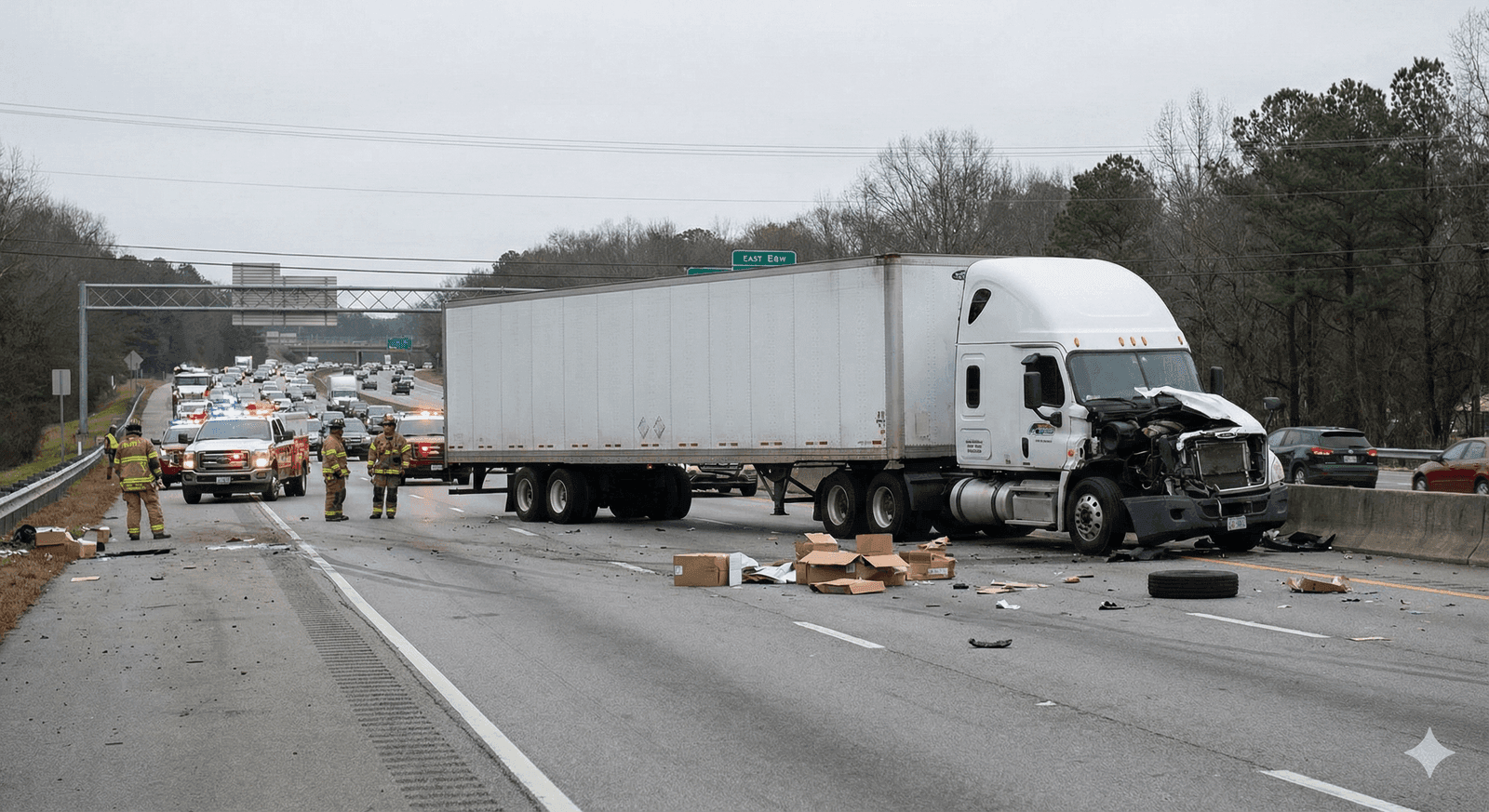
Orlando Delivery Truck Accident Lawyer — Amazon, FedEx, UPS & Courier Crash Claims
Delivery truck accidents are among the fastest-growing personal injury claim categories in Orlando. Amazon operates a major delivery hub near Orlando International Airport. FedEx and UPS maintain large Central Florida distribution facilities. Together with DHL, USPS, Instacart, and dozens of independent courier operations, these companies put thousands of delivery vehicles on Orlando's residential streets, commercial corridors, and downtown business districts every day.
Call HOV Law at (407) 801-0101 for a free consultation with an Orlando delivery truck accident lawyer — available 24/7.
Who Is Liable When an Amazon, FedEx, or UPS Truck Hits You in Orlando?
- Delivery company liability in Orlando depends on the driver's employment relationship with the parent company. Our guide on who is liable for a truck accident in Florida covers how that relationship is established:
- Amazon Delivery Service Partners (DSPs)—Amazon uses thousands of small DSP companies that hire their own drivers under Amazon's brand and standards. Amazon sets the route, the delivery targets, the uniform, the vehicle specs, and the performance metrics — while claiming DSP drivers are not Amazon employees. Courts have held Amazon liable in some cases when Amazon exercised extensive operational control over the DSP.
- FedEx Ground Contractors—FedEx Ground has historically classified drivers as independent contractors, though this classification has been successfully challenged in multiple states. HOV Law analyzes the degree of FedEx's operational control over the driver's schedule, routes, and vehicle maintenance.
- UPS Package Car Drivers—UPS drivers are typically direct employees covered by UPS's commercial liability policy. Liability claims against UPS proceed more directly.
- USPS Vehicles—Claims against the U.S. Postal Service require filing an administrative claim under the Federal Tort Claims Act before filing suit in federal court. HOV Law handles FTCA delivery truck claims in Orlando.
- DoorDash, Instacart, and Gig Couriers—App-based delivery platforms present evolving liability questions. The driver's personal auto insurance, the platform's commercial insurance, and potential negligent entrustment claims all factor into the recovery analysis.
Amazon DSP Liability in Florida — A Deep Dive
Amazon's Delivery Service Partner (DSP) program is the structure responsible for most of the Amazon-branded delivery vans operating on Orlando-area streets. Understanding how it works is essential to identifying the correct defendant when an Amazon van crashes in Lake Nona, Avalon Park, Dr. Phillips, or any other Orlando neighborhood.
How the DSP Model Works — Amazon contracts with small businesses (DSPs) that operate Amazon-branded delivery vans from Amazon delivery stations. The DSP is the formal employer of the van driver, providing payroll, benefits, and direct supervision on paper. Amazon supplies the routes, the daily package volume, the navigation app (Mentor / Flex), the uniforms, the van branding, and detailed performance metrics. The DSP is paid based on those metrics. Amazon's own employees include only the delivery-station staff and corporate personnel — not the drivers in the vans.
The Amazon Flex Distinction — Amazon Flex is a separate gig program in which drivers use their own personal vehicles to deliver Amazon packages, Whole Foods groceries, or Amazon Fresh orders. Flex drivers are classified as independent contractors of Amazon directly (not of any DSP) and operate under Amazon's commercial automobile liability program when on an active delivery block. Crashes involving an unbranded vehicle that turns out to be an Amazon Flex driver follow a different liability analysis than crashes involving a branded DSP van.
Amazon's Commercial Auto Coverage — Amazon maintains a commercial auto insurance program (currently administered with established commercial auto carriers) covering DSP-operated branded vehicles. The policy is structured so that the DSP's own commercial auto policy is primary up to a layer, with Amazon's coverage sitting above it. For a serious Orlando crash with substantial injuries, the available insurance limits often span multiple policy layers, but accessing those layers requires identifying the correct defendants and policies.
The "Control" Test in Florida — Florida courts apply a fact-specific control test to determine whether a principal can be held vicariously liable for an independent contractor's acts. The test looks at: who set the schedule; who supplied the vehicle, equipment, and route; who imposed performance metrics and discipline; who handled payment; and what the contract documents say. Amazon's operational control over DSPs is substantial under most of these factors. Recent litigation in Florida and other states has produced rulings that survive Amazon's independent-contractor defense where the operational control is well-documented.
Identifying the DSP in an Orlando Crash — Branded Amazon delivery vans display an Amazon "smile" logo and standard livery, but the operating DSP is rarely identified on the van itself. The DSP name typically appears on insurance documentation, registration records, and delivery-station records. HOV Law obtains this information through the FHP crash report, post-crash records requests to Amazon, and discovery in litigation. Naming the correct DSP and Amazon as co-defendants from the outset preserves both layers of recovery.
FedEx Ground vs FedEx Express vs FedEx Freight — Three Legally Distinct Companies
Most Orlando residents see "FedEx" as a single brand. From a legal-liability standpoint, FedEx operates three separate corporate divisions that handle different shipments under different employment models, with different insurance and different defense strategies. Identifying the correct FedEx entity is essential to building the case.
FedEx Ground — FedEx Ground operates the ground-shipping network for parcels, including most of the smaller package deliveries Orlando residents see in their neighborhoods. FedEx Ground has historically used "Independent Service Providers" (ISPs) — small businesses that employ the actual drivers but operate under FedEx Ground's standards, scheduling, and branding. FedEx Ground's independent-contractor model has been litigated extensively, with significant rulings in some jurisdictions reclassifying ISP drivers as FedEx employees for liability and labor-law purposes. The current ISP arrangement still inserts a contractor entity between FedEx Ground and the driver.
FedEx Express — FedEx Express is the air-express division that operates the priority overnight and time-definite delivery service. FedEx Express drivers handling ground portions of the route are direct FedEx Express employees, not ISP contractors. This produces a more direct path to corporate liability than the FedEx Ground model.
FedEx Freight — FedEx Freight is the LTL (less-than-truckload) freight carrier within the FedEx family, operating heavier commercial vehicles that move palletized freight between distribution centers and customers. FedEx Freight drivers are direct employees, and the vehicles are typically Class 7 or 8 commercial trucks subject to the full FMCSA regulatory framework, not the lighter parcel-delivery framework that governs FedEx Ground vans.
Identifying the Right FedEx Entity at the Scene — The vehicle's livery indicates the division (Ground vans are different from Express vans, and Freight tractor-trailers are obviously distinct). The FHP crash report typically captures the USDOT number and operating authority of the carrier. Same-day photo documentation of the truck's identifying markings and same-day records requests preserve the information needed to sue the correct FedEx division.
USPS Delivery Truck Crashes — Federal Tort Claims Act Procedure
The United States Postal Service is part of the federal government. When a USPS mail truck or LLV (Long-Life Vehicle) causes a crash in Orlando, the case proceeds under the Federal Tort Claims Act (FTCA), 28 U.S.C. § 2671 et seq. — not under ordinary Florida tort procedure. The FTCA procedure imposes specific procedural requirements that trap unwary plaintiffs into losing valid claims.
The Administrative Claim Requirement — Standard Form 95 — A USPS crash victim cannot file suit immediately. Instead, the claimant must first submit a written administrative claim to USPS using Standard Form 95 (SF-95), specifying a dollar amount of damages claimed. The SF-95 must be received by USPS within 2 years of the date of the crash under 28 U.S.C. § 2401(b). USPS then has 6 months to investigate and respond — either approving, denying, or failing to act on the claim.
The 6-Month Administrative Investigation — During the 6-month investigation period, USPS reviews the claim, requests medical records, and either tenders a settlement, denies the claim outright, or simply lets the 6-month period expire without acting. The claimant cannot file suit during these 6 months unless USPS issues a final denial earlier.
The 6-Month Litigation Window After Denial — If USPS denies the claim (or 6 months passes without action), the claimant has 6 months from the date of denial to file suit in federal court — specifically, the U.S. District Court for the Middle District of Florida for crashes in the Orlando area. This 6-month litigation deadline is strictly enforced; missing it forfeits the claim entirely.
Federal Court, Not State Court — FTCA claims are always filed in federal court, never in state court. The substantive law applied is the tort law of the state where the crash occurred (Florida law, including Florida comparative-fault and PIP rules), but the procedural rules are federal. No jury trial is available under the FTCA — these cases are tried to the federal judge alone.
Damages Caps and Special Rules — The FTCA does not impose damages caps comparable to Florida's sovereign-immunity caps, but it does prohibit certain categories of recovery (no pre-judgment interest, no punitive damages against the government). Attorney fees are capped at 25% of any settlement or judgment under 28 U.S.C. § 2678. HOV Law's contingency fee complies with this federal cap on FTCA cases.
Gig Economy Delivery Crashes — DoorDash, Instacart, Shipt, Uber Eats in Orlando
The gig-economy delivery model produces a different liability structure than traditional delivery companies. Drivers use their own personal vehicles to fulfill platform-arranged deliveries. The platform claims the driver is an independent contractor, not an employee, and the driver's personal auto insurance typically excludes commercial delivery use. The result is a triangle of insurance coverage that is structurally similar to rideshare claims under Florida's TNC statute.
Period-Based Coverage Layers (Analogous to Rideshare) — While Florida's Transportation Network Company (TNC) statute at FL § 627.748 was written for passenger-rideshare services, the period-based insurance structure has become the de facto industry standard for delivery platforms as well. Period 1 (app on, no delivery accepted) is typically covered by lower contingent liability; Period 2 (delivery accepted, en route to pickup) and Period 3 (delivery in progress) are typically covered by significantly higher platform commercial coverage — often $1 million in third-party liability during active delivery.
DoorDash Driver Crashes — DoorDash maintains commercial auto coverage that activates when a driver is actively on a delivery. The coverage applies on a contingent basis (after the driver's personal policy denies) and varies by state. Orlando crashes involving a DoorDash driver mid-delivery typically access DoorDash's commercial coverage layer; crashes during a "no active delivery" period rely on the driver's personal coverage and any contingent coverage that applies.
Instacart and Shipt Driver Crashes — The grocery-delivery platforms operate under similar period-based coverage structures. Coverage activates during active shopping and delivery and recedes when the driver is not engaged with the platform.
Uber Eats and Postmates Crashes — Uber Eats deliveries by Uber drivers are typically covered under the same TNC commercial policy that covers passenger rideshare trips. Postmates (now part of Uber) operates under Uber's coverage framework.
Why This Matters in Orlando — Orlando's tourism economy, residential density, and large young-professional population produce extremely high gig-delivery activity. When a gig driver causes a crash on Colonial Drive, in the International Drive corridor, or in any Orlando residential neighborhood, the correct insurance access often requires identifying the platform, establishing which delivery period was in effect at the time of the crash, and pursuing both the platform's commercial coverage and any applicable personal coverage. HOV Law preserves the platform's app data, delivery acceptance and pickup timestamps, and route records immediately upon retention.
Florida Laws That Affect Your Case
Statute of Limitations
In Florida, you have a limited time to file your claim: 2 years for negligence (FL Statute § 95.11). Missing this deadline typically means you lose your right to compensation permanently.
“Time is your most valuable asset after an injury. Contact an Orlando attorney immediately to ensure your claim is preserved.”
Modified Comparative Negligence
Florida follows a modified comparative negligence system. If you are found to be more than 50% at fault, you are barred from recovering any damages. Otherwise, your compensation is reduced by your percentage of fault.
Florida Insurance System
Florida operates under a No-Fault (PIP required) system. $10,000 PIP coverage required.
Key Florida Legal Facts
Federal Hours-of-Service Regulations
Commercial trucks and their drivers are governed by federal FMCSA regulations, not just state traffic law. Drivers are capped at 11 hours of driving after 10 consecutive hours off duty, cannot drive past the 14th hour after coming on duty, and must take a 30-minute break after 8 hours behind the wheel (49 CFR § 395). Violations of these hours-of-service rules — provable through the truck's electronic logging device — are powerful evidence of negligence in a truck accident claim.
Local Knowledge: Orlando
High-Risk Roads & Highways
- I-4 (one of the deadliest highways in America)
- SR 408
- Colonial Drive (SR 50)
- Orange Blossom Trail
Local Courts
- Orange County Courthouse
- Ninth Judicial Circuit Court
Areas We Serve Near Orlando
- Kissimmee
- Winter Park
- Sanford
- Altamonte Springs
- Apopka
Orlando Landmarks
- Downtown Orlando
- International Drive
- Lake Eola
- Universal Studios
What Compensation May Cover
Under Florida law, you may be entitled to recover damages for the full impact of your injuries.
Economic Damages
- • Medical bills (past & future)
- • Lost wages & earning capacity
- • Property damage
- • Rehabilitation costs
Non-Economic Damages
- • Pain and suffering
- • Mental anguish
- • Loss of consortium
- • Physical impairment
Related Practice Areas in Orlando
Delivery Truck Accidents cases often involve overlapping injuries and legal claims. Our Orlando attorneys also handle these related areas:
Other Personal Injury Services in Orlando
Also serving Orlando for Criminal Defense:
Serge Hovhanessian, Esq.
Founding Attorney at HOV Law | Florida Bar | Million Dollar Advocates Forum | Top 40 Under 40 Trial Lawyers
Attorney Hovhanessian represents personal injury victims across Florida — no fee unless we win.Read full bio →
Verified 5-Star Google Reviews
What Orlando Clients Say About HOV Law
A 5.0-star average across 293 Google reviews. Hear directly from clients we've represented in Orlando and across Florida.
Orlando Delivery Truck Accidents FAQs
Can I sue Amazon if their delivery driver hit me in Orlando?
Yes — in many cases. Amazon's Delivery Service Partner (DSP) program inserts a contractor company between Amazon and the van driver, and Amazon formally claims DSP drivers are not Amazon employees. However, Florida courts apply a fact-specific operational-control test, and Amazon's control over DSPs is substantial — Amazon sets routes, sets delivery-per-hour targets, supplies the branded vehicles, sets uniforms and equipment, and disciplines DSPs based on performance metrics. Recent litigation in Florida and other states has produced rulings that survive Amazon's independent-contractor defense where the operational control is well-documented. HOV Law typically names both the DSP and Amazon as co-defendants from the outset to preserve both layers of recovery.
What if a FedEx truck caused my Orlando crash — does it matter which FedEx division?
Yes, it matters significantly. FedEx operates three legally distinct corporate divisions: FedEx Ground (uses Independent Service Provider contractors for parcel delivery), FedEx Express (air-express with direct-employee drivers), and FedEx Freight (LTL freight with direct-employee drivers operating heavier commercial vehicles). The liability theory and the defense strategy differ for each. The vehicle's livery, the FHP crash report's USDOT entry, and same-day records requests are how we identify the correct FedEx entity. UPS drivers, by contrast, are typically direct UPS employees, which produces a more direct path to corporate liability.
How do USPS truck accident claims work in Orlando?
USPS mail truck crashes proceed under the Federal Tort Claims Act (FTCA), not standard Florida tort procedure. You must file an administrative claim using Standard Form 95 (SF-95) with USPS within 2 years of the crash. USPS then has 6 months to investigate and either approve, deny, or fail to act. If USPS denies or fails to act, you have 6 months from that point to file suit in the U.S. District Court for the Middle District of Florida — federal court, no jury, judge-tried. Punitive damages against the federal government are not available under the FTCA, and attorney fees are capped at 25% under 28 U.S.C. § 2678. The procedural traps in FTCA cases are real; do not attempt this without counsel familiar with federal tort practice.
What if a DoorDash, Instacart, or Uber Eats driver caused my Orlando crash?
Gig-economy delivery platforms operate under period-based commercial insurance structures similar to rideshare. Coverage typically activates when the driver accepts a delivery and continues through pickup and delivery completion — often providing $1 million in third-party liability during active delivery. Coverage during "app on, no delivery accepted" periods is more limited. HOV Law preserves the platform's app data, delivery-acceptance timestamps, route records, and any driver-mode indicators to establish which insurance period was in effect at the moment of the crash, then pursues both the platform's commercial coverage and any applicable personal coverage.
What evidence is important in a delivery truck accident case in Orlando?
Critical evidence includes route data from the driver's app or delivery device (Mentor for Amazon DSPs, FedEx and UPS proprietary apps, platform apps for gig drivers); dashcam footage (most modern Amazon DSP vans and many FedEx Ground vehicles have front and inward-facing cameras); the driver's delivery log showing stops before and after the crash; the employment, ISP, or DSP contract and operational documents; the company's driver safety policies and prior-incident records; and the company's commercial auto insurance declarations page. HOV Law demands preservation of all of this immediately upon retention — most platforms overwrite delivery-app data on retention cycles measured in days or weeks.
What if a delivery driver hit me while backing up in an Orlando neighborhood?
Backing-up crashes are the most common delivery truck accident type in Orlando residential neighborhoods like Lake Nona, Avalon Park, Dr. Phillips, and Baldwin Park. The driver has a duty to check all blind spots, use a spotter when available, and proceed slowly in reverse. Most modern Amazon DSP vans have rearview cameras and beepers; failure to use available safety equipment is itself evidence of negligence. Dashcam footage, delivery route logs, and telematics data from the vehicle are critical evidence. HOV Law preserves this data immediately and pursues both the driver and the company. Backing-up crashes against children or cyclists in residential settings often support enhanced damages claims given the foreseeability of the risk.
Hit by a Delivery Truck
in Orlando?
Whether the vehicle was an Amazon van, a FedEx truck, a UPS package car, or a local courier, HOV Law identifies the correct corporate defendant and pursues maximum compensation for your Orlando delivery truck crash.